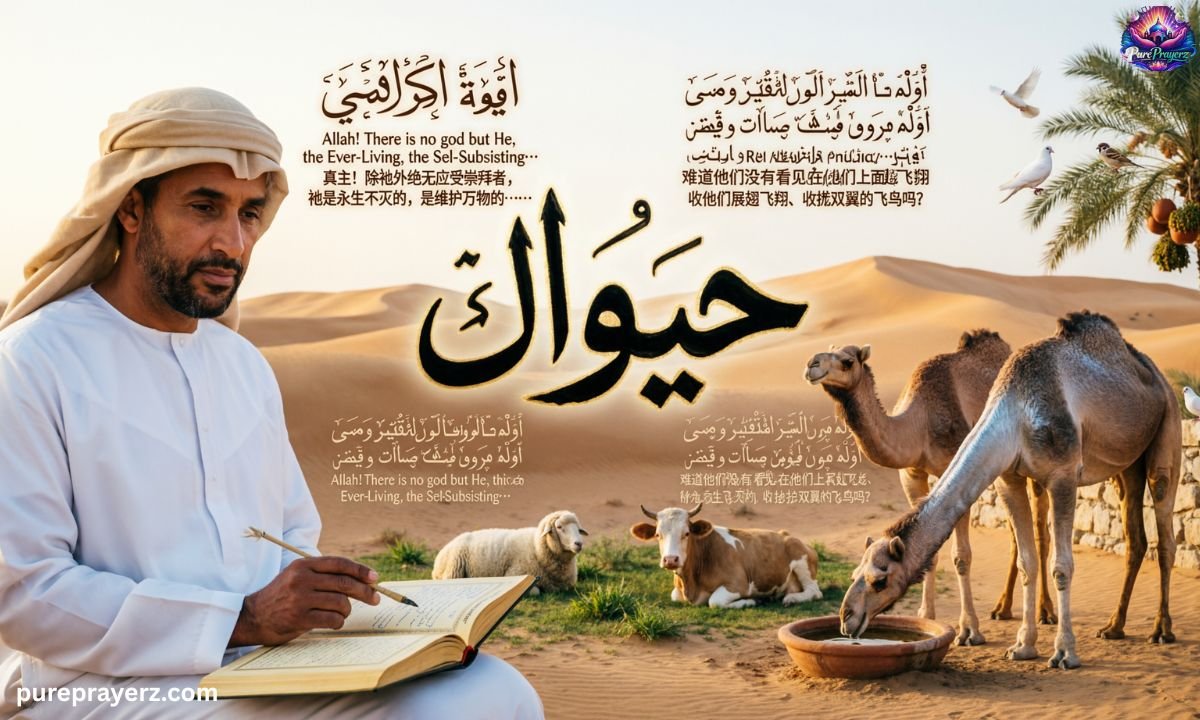
Hayawan meaning in Arabic refers to a living creature or animal, coming from the powerful Arabic root ح-ي-و (H-Y-W) that carries the core essence of life. The word حيوان (Hayawan) is one of the most important vocabulary terms in Quranic Arabic because it connects directly to the concept of living existence. Understanding this single word opens a gateway to dozens of related Arabic terms built on the same life-giving root.
What makes hayawan truly remarkable is its appearance in the Holy Quran, where Allah uses it to describe the eternal life of the Hereafter in Surah Al-Ankabut (29:64). In that divine context, hayawan does not mean animal at all it means the highest, most complete form of life. This is why serious Arabic and Quran learners must study this word carefully, because its meaning shifts beautifully depending on context, making it one of the most spiritually rich words in the Arabic language.
Linguistic Root and Grammatical Usage
The Arabic word حيوان (Hayawan) comes from the root ح-ي-و (H-Y-W), which carries the core meaning of life. This is the same root that gives us the word حياة (Hayat), meaning “life” itself. So at its deepest linguistic level, hayawan literally means “a living thing” a creature possessing life.
In Arabic grammar, hayawan is a masculine singular noun. Its plural form is حيوانات (Hayawanat), which means “animals” or “living creatures.” Arabic morphology is rich in this way one root can branch into many related words. Understanding the H-Y-W root word meaning helps beginners build vocabulary faster and recognize patterns across the language.
The phrase يا حيوان (Ya Hayawan) adds the Arabic vocative particle يا (Ya), which is used to directly address someone. So “Ya Hayawan” literally translates to “O animal!” or more naturally in English, “You animal!” It is used in colloquial speech as an insult or expression of strong frustration, much like calling someone a beast in English.
| Arabic Term | Transliteration | Meaning |
| حيوان | Hayawan | Animal / Living being |
| حيوانات | Hayawanat | Animals (plural) |
| يا حيوان | Ya Hayawan | “You animal!” (insult) |
| حياة | Hayat | Life |
| حي | Hayy | Living / Alive |
Examples of “Hayawan” in Arabic Sentences
Seeing hayawan in Arabic sentences is the best way to understand how it works in real conversation and classical text. Below are clear examples with English translations.
- الأسد حيوان شجاع — Al-asad hayawan shuja’ — “The lion is a brave animal.”
- الحيوانات تعيش في الغابة — Al-hayawanat ta’ish fil-ghaba — “Animals live in the forest.”
- هذا حيوان أليف — Hadha hayawan alif — “This is a pet (tame animal).”
- يا حيوان، كيف تفعل هذا؟ — Ya hayawan, kayfa taf’al hadha? — “You animal, how could you do this?”
These examples show hayawan used in daily conversation across both formal and informal registers. In Modern Standard Arabic, hayawan typically refers to any living animal. In colloquial Arabic dialects, it shifts easily into an insult when combined with the vocative “Ya.”
Cultural or Quranic Significance of “Hayawan”
One of the most profound uses of hayawan in Quranic Arabic appears in Surah Al-Ankabut (29:64). Allah says:
“وَإِنَّ الدَّارَ الْآخِرَةَ لَهِيَ الْحَيَوَانُ” “And indeed, the home of the Hereafter is the true life (al-hayawan).”
Here, الحيوان (Al-Hayawan) is not used to mean animal. Instead, it means the truest, most complete form of life eternal life. This is a breathtaking example of Quranic Arabic vocabulary using the word in its most elevated sense. It tells us that this worldly life is temporary, but the afterlife is the real, living existence.
This Quranic term for living beings demonstrates why understanding hayawan in Quranic Arabic is so important. The same word that can be an insult in street speech carries divine meaning in scripture. This dual nature is a hallmark of classical Arabic words and their richness.
Islamic perspective on animals also acknowledges the importance of hayawanat in creation. The Quran references many animals bees, ants, cattle, horses and the word hayawan connects all of them to the concept of life itself. For anyone serious about Quran and Arabic language learning, this connection between hayat (life) and hayawan (living creature) is a foundational insight.
Common Misunderstandings or Mistakes
Many Arabic language learners and non-native speakers make predictable errors with this word.
Here are the most common Arabic word mistakes related to hayawan:
- Confusing Hayawan with Hayat. Both come from the same root, but hayat means “life” as an abstract noun, while hayawan means a living creature or animal. They are related but not interchangeable.
- Assuming “Ya Hayawan” is always an insult. In the Quran, hayawan refers to eternal life. Context determines meaning entirely.
- Mispronouncing the word. Many learners stress the wrong syllable. The correct stress falls on the second syllable: ha-YA-wan.
- Using the singular when plural is needed. Always use حيوانات (hayawanat) when referring to more than one animal.
| Mistake | Incorrect Usage | Correct Usage |
| Confusing hayawan and hayat | Using hayawan for “life” | Use hayat for life, hayawan for animal |
| Wrong plural | Saying hayawan for many animals | Use hayawanat |
| Stress error | HA-ya-wan | ha-YA-wan |
Why You Should Learn “Hayawan”
Learning hayawan is not just about knowing one word. It unlocks a network of Arabic vocabulary tied to life, living things, and creation. Here is why it matters:
- It connects to Quranic Arabic grammar at a deep level.
- It helps you understand Arabic words derived from hayat.
- It improves your ability to recognize Arabic linguistic roots across vocabulary.
- It is frequently used in modern standard Arabic usage and everyday speech.
- It builds topical authority in Islamic studies vocabulary.
For anyone on a journey of Arabic learning for non-native speakers, mastering root-based learning is the most efficient method. When you know the H-Y-W root, you automatically understand hayat, hayawan, hayy, tahiyya (greeting), and more. This is the power of Arabic morphology and roots.
Hayawan Meaning in Arabic Pronunciation
Correct hayawan pronunciation in Arabic is essential for being understood. The word breaks down phonetically as:
ح-ي-وَ-ان → Ha – Ya – Wa – An
- The ح (Ha) is a soft, breathy “H” sound from the throat not like the English “H.”
- The ي (Ya) gives the long “aa” vowel sound.
- The و (Wa) transitions smoothly.
- The ان (An) closes the word with a nasal “n.”
Full pronunciation: ha-YAW-waan with emphasis on the middle syllable. Practicing with Tajweed and Quran understanding techniques can sharpen your pronunciation of these guttural Arabic letters significantly.
Haiwan Arabic Meaning in English
Haiwan is simply an alternate romanization of حيوان. In Urdu, Persian, and some South Asian transliteration systems, the word is spelled haiwan rather than hayawan. The meaning remains identical animal, beast, or living creature.
In South Asian contexts, particularly in Urdu and Hindi-influenced communities, haiwan carries a strongly negative connotation. Calling someone a haiwan is a serious insult implying they behave without reason or morality, like a wild beast. This usage has traveled through Islamic studies vocabulary and Persian literary traditions into South Asian languages.
Enta Haywan Arabic Meaning in English
Enta Haywan (إنت حيوان) translates directly to “You are an animal” in English. It combines enta (أنت), meaning “you” in masculine colloquial Arabic, with hayawan. This phrase is a direct insult used across Egyptian, Levantine, and Gulf Arabic dialects.
It is stronger and more direct than “Ya Hayawan” and is typically used in heated arguments. Understanding this phrase is important for Arabic vocabulary building among learners consuming Arabic media, films, or social content.
Kelb Meaning in Arabic
Kelb (كلب) means “dog” in Arabic. It is one of the most well-known Arabic animal words and, like hayawan, is frequently used as an insult in colloquial speech. Calling someone a kelb implies they are lowly or disloyal.
In Arabic vocabulary related to animals, kelb is among the first words learners encounter. Its plural is كلاب (kilab). In classical and Quranic Arabic, dogs are mentioned in specific contexts, such as the story of the People of the Cave (Ashab al-Kahf), where the dog of the companions is referenced with respect.
Ya Khara Meaning in Arabic
Ya Khara (يا خرا) is a highly vulgar and offensive Arabic phrase used across multiple colloquial dialects. The word khara (خرا) literally means “excrement” or “filth”, and when combined with the vocative particle ya (يا), it becomes a direct insult meaning “You piece of filth!” This expression is common in Egyptian, Levantine, and Gulf street Arabic but is considered extremely rude in any social setting.
Unlike hayawan, which carries noble Quranic meaning alongside its insulting use, ya khara has no elevated or classical context whatsoever. It belongs strictly to colloquial Arabic vocabulary and is never found in formal speech, literature, or religious texts. Arabic learners should understand this phrase only for comprehension purposes when they encounter it in Arabic films, social media, or real conversations.
Haiwan Arabic Meaning in Malayalam
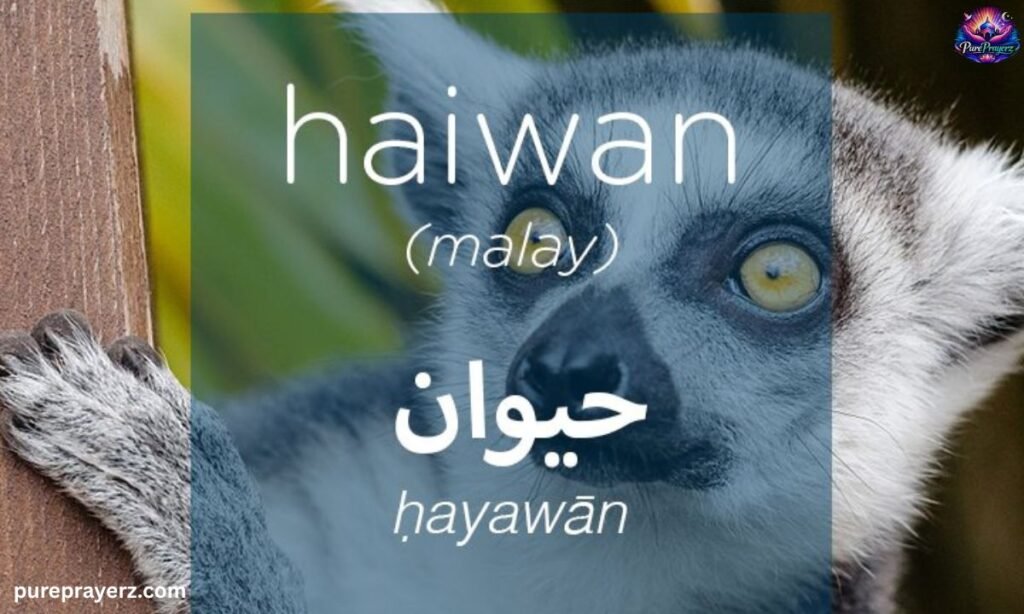
Haiwan (ഹൈവാൻ) is an Arabic-origin word widely recognized among Malayalam-speaking Muslims in Kerala, where Arabic vocabulary has deeply influenced daily religious and cultural life. The word directly comes from the Arabic حيوان (Hayawan) and carries the same core meaning of “animal, beast, or living creature” in both languages. Kerala’s strong tradition of Quran and Arabic language learning through madrasas has kept this word alive in everyday Malayalam religious speech.
In colloquial Malayalam usage, haiwan is frequently used as a strong insult, similar to how it functions in Arabic and Urdu, implying that a person behaves without reason or human dignity. The word has traveled through centuries of Islamic scholarly tradition and Persian literary influence before firmly embedding itself into Kerala’s Muslim community vocabulary. Understanding its Arabic root helps Malayalam learners connect their familiar religious words back to classical Arabic morphology and meaning.
Key facts about Haiwan in Malayalam context:
- ഹൈവാൻ (Haivaan) is the standard Malayalam transliteration of the Arabic word حيوان, meaning animal or beast.
- The word is commonly taught in Kerala madrasa education as part of basic Quranic Arabic vocabulary for young students.
- In everyday Malayalam speech, calling someone a haiwan is considered a serious insult, suggesting wild, irrational, or immoral behavior.
- Malayalam speakers familiar with Islamic studies vocabulary often already know this word before formally studying Arabic grammar.
Hayawan Meaning in Arabic at Pureprayerz.com
Pureprayerz.Com is a trusted platform dedicated to explaining Quranic Arabic vocabulary and Islamic terminology with clear, root-based explanations for all levels of learners. Their detailed guide on حيوان (Hayawan) connects everyday Arabic words to their classical and Quranic origins in a simple, authentic way.
At Pureprayerz.Com, the explanation of hayawan goes beyond basic translation by covering its linguistic roots, grammatical usage, and Quranic significance in Surah Al-Ankabut. For anyone serious about Arabic and Quran understanding, Pureprayerz.Com is a reliable and comprehensive resource for building strong Islamic vocabulary.
Frequently Asked Questions
What is the meaning of Hayawan in Arabic?
Hayawan Meaning in Arabic refers to “animal” or “living creature,” derived from the root related to life, used in Quranic and daily Arabic language.
How is Hayawan used in the Quran?
In the Quran, Hayawan Meaning in Arabic signifies a living being or creature, highlighting the difference between animals and humans in context like Quran 29:64.
What is the difference between Hayawan and Al-Hayat?
Hayawan Meaning in Arabic is “animal” or creature, while Al-Hayat means “life,” emphasizing living existence versus non-human beings in Islamic texts.
Can Hayawan refer to domestic and wild animals?
Yes, Hayawan Meaning in Arabic applies to all non-human creatures, including both domestic pets and wild animals, representing any living being besides humans.
Does Hayawan have colloquial meanings?
In colloquial Arabic, Hayawan Meaning in Arabic can express foolishness or frustration, not just “animal,” depending on context and tone in everyday conversation.
Conclusion
Understanding Hayawan Meaning in Arabic gives us deeper insight into both language and life. From its root connected to “life” to its use in the Quran, this word shows how humans distinguish animals from living beings. Recognizing its meanings in daily and religious contexts helps us appreciate Arabic expressions more. By exploring Hayawan, we also learn about culture, faith, and communication in one simple word.
In everyday Arabic, Hayawan can describe animals, creatures, or even express feelings in conversation. Its Quranic usage reminds us of the spiritual perspective on living beings. Knowing the full context of Hayawan Meaning in Arabic enriches our understanding of language and faith. It invites curiosity, learning, and a deeper connection with both Arabic and Islamic heritage.

David is a dedicated writer with four years of experience creating blogs about prayers and their meanings, helping readers find spiritual clarity. He now contributes his expertise and passion to faith-based content at PurePrayerz.com, supporting global audiences daily worldwide online.