The word hayat meaning goes far beyond a simple translation of “life.” It carries deep linguistic, spiritual, cultural, and religious dimensions that have shaped Arabic language, Islamic thought, and everyday communication for centuries. This article offers a complete hayat meaning overview by exploring its Arabic roots, grammatical usage, Quranic depth, and modern expressions across cultures.
You will learn what does hayat mean in daily speech, how it appears in classical Arabic, and why it holds such importance in Islamic studies. From hayat meaning in Urdu, Turkish, and German to its symbolic meaning, spiritual meaning, and name usage, this guide explains the meaning of hayat in simple words while providing a deep explanation for students, researchers, and curious readers alike.
Essential Facts and Insights About “Hayat”
| Fact | Details |
| Word | Hayat (حياة) |
| Language | Arabic |
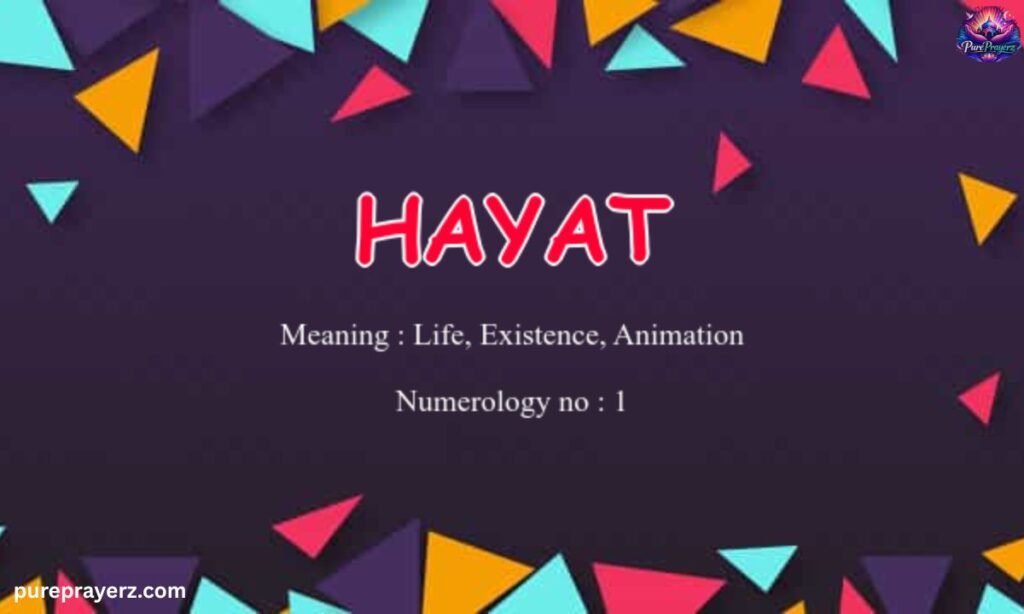
| Literal Meaning | Life, existence, vitality |
| Grammatical Form | Feminine verbal noun (masdar) |
| Root | ḥ-y-y (ح ي ي) – relates to living, revival, and vitality |
| Plural Form | Hayaat (حَيَوات) |
| Common Derived Verbs | يحيي (yuhyi) – “to give life” |
| Quranic Usage | Refers to both worldly life (hayat al-dunya) and eternal life (hayat al-akhirah) |
| Cultural Significance | Symbolizes life, purpose, spiritual awareness, and moral responsibility in Arabic and Islamic culture |
| Usage in Names | Popular as a Muslim baby name for both boys and girls; signifies vitality and blessing |
| Other Languages | Turkish: hayat – life; Urdu: زندگی – life; German: Leben – life |
| Common Mistakes | Confused with Haya (modesty), Hayawan (animal), or plural Hayaat |
| Pronunciation Tip | Two smooth syllables: ha-yat; avoid stretching “ya” too long |
| Symbolic Meaning | Represents life’s journey, responsibility, spiritual growth, and vitality |
The Meaning of “Hayat” in Arabic
The word hayat in Arabic literally translates to “life,” but its meaning goes far beyond mere physical existence. It encompasses vitality, consciousness, growth, and purpose, making it a term rich in linguistic, spiritual, and cultural significance. Hayat meaning in Arabic reflects not only living but also thriving, experiencing, and fulfilling one’s responsibilities in both worldly and spiritual contexts.
In daily use, hayat can refer to ordinary life experiences, emotional states, or moral lessons. Classical Arabic literature often employs hayat symbolically to express the beauty, fragility, and value of life. Understanding hayat in this language provides learners with insight into the Arabic worldview, Islamic philosophy of life, and how life is perceived as both a gift and a responsibility.
Core Definition and Concept
The meaning of hayat in Arabic comes from the idea of life, existence, vitality, and continuous being. In simple terms, hayat word meaning refers to “life” in its fullest sense physical, spiritual, and moral. The Arabic word for life is not limited to biological existence. Instead, it includes awareness, purpose, movement, and growth.
In classical Arabic, hayat literal meaning points to something that is alive, active, and meaningful. This makes hayat a central concept in Arabic vocabulary life studies and Islamic philosophy of life. When Arabs say “hayat,” they may be talking about daily living, emotional depth, or spiritual awakening.
From a dictionary perspective, hayat meaning short definition is “the state of being alive.” However, hayat meaning explained properly includes layers of symbolism. Life is viewed as a blessing, a responsibility, and a test. This broader definition of hayat forms the foundation of many Islamic teachings about life and existence.
Linguistic Root and Grammatical Usage
The word hayat originates from the Arabic root ḥ-y-y (ح ي ي), which conveys the concept of living, revival, and vitality. This root forms many related words in Arabic, such as حيّ (alive) and يحيي (to give life). Understanding this root is essential for grasping the deeper meaning of hayat and its connection to life, existence, and spiritual renewal.
Grammatically, hayat is a feminine verbal noun (masdar) in Arabic. It can be used in definite or indefinite forms and appears frequently in classical texts, modern literature, and religious writings. Learning its structure helps with correct sentence formation and comprehension.
Common Usage Patterns:
- Definite form: الحياة – “the life” (used in formal or Quranic context)
- Indefinite form: حياة – “a life” or “life in general”
- Verb derived: يحيي – “he gives life” or “he revives”
By understanding the linguistic root and grammatical usage of hayat, learners can expand their vocabulary, correctly interpret Quranic and literary texts, and appreciate the semantic depth of Arabic words related to life, vitality, and spiritual meaning.
Arabic Root and Word Structure
To understand hayat meaning etymology, we must look at the Arabic root ḥ-y-y (ح ي ي). This root conveys ideas of living, reviving, and giving life. The Arabic root h-y-y meaning appears in many related words such as “حيّ” (alive) and “يحيي” (to give life).
From a linguistic standpoint, hayat linguistic meaning is a verbal noun (masdar) that functions as a feminine noun in Arabic grammar. It is commonly used with definite and indefinite forms, making it flexible in both classical Arabic and modern usage.
In Arabic word studies, hayat meaning semantics shows how one root can create multiple meanings connected to life, dignity, and renewal. This makes hayat meaning vocabulary especially important for students of Arabic, Quranic Arabic meanings, and Islamic education vocabulary. Understanding this root also helps learners grasp broader Arabic language semantics and arabic religious terms.
Must Read: Tariq Meaning in Arabic: Origin, History & Name Facts
Examples of “Hayat” in Arabic Sentences
Understanding hayat becomes easier when seen in context. Using it in sentences helps learners grasp both its literal and symbolic meanings. In Arabic, hayat can describe physical life, emotional experiences, or spiritual lessons, making it a versatile and widely used word.
Here are some common examples:
| Arabic Sentence | Translation | Usage Context |
| الحياة جميلة | Life is beautiful | Expressing positivity about life |
| هذه حياة صعبة | This is a difficult life | Describing challenges or struggles |
| الحياة اختبار | Life is a test | Spiritual or moral reflection |
| حياتي ثمينة | My life is precious | Emotional or personal expression |
These examples show how hayat meaning in daily use adapts to different situations. By practicing such sentences, learners can improve their vocabulary, understand Quranic expressions, and communicate effectively in both casual and formal Arabic settings. Using hayat correctly in sentences also strengthens comprehension of cultural and spiritual nuances in language.
Daily Use and Practical Understanding
Seeing hayat meaning with example makes the concept clearer and more practical. In daily Arabic conversation, hayat meaning in daily use appears naturally and frequently.
Here are a few simple examples to explain hayat meaning simple words:
- الحياة جميلة – Life is beautiful
- هذه حياة صعبة – This is a difficult life
- الحياة اختبار – Life is a test
These examples show that hayat meaning modern usage applies to emotions, challenges, and reflections on existence. For students, hayat meaning for students becomes easier when linked with everyday expressions. In Arabic vocabulary life lessons, hayat is often contrasted with “mawt” (death), highlighting the difference between hayat and mawt in Islamic worldview life discussions.
Cultural or Quranic Significance of “Hayat”
The word hayat holds deep cultural and spiritual significance across Muslim societies. In Arabic culture, it is not only a term for physical life but also a symbol of vitality, purpose, and moral responsibility. Literature, poetry, and daily expressions frequently use hayat to convey the richness of existence, human experiences, and the beauty of living meaningfully.
This shows that hayat carries symbolic meaning that goes beyond simple survival or everyday activities.In the Quran, hayat is used to differentiate between worldly life (hayat al-dunya) and eternal life in the hereafter (hayat al-akhirah). Worldly life is seen as temporary, a test of character, and an opportunity to follow divine guidance.
Eternal life, on the other hand, represents reward, spiritual fulfillment, and closeness to God. This dual perspective makes hayat central in Islamic teachings, emphasizing that life is both a blessing and a responsibility, connecting believers to their faith and purpose.
Quranic and Spiritual Dimensions
The Quranic word hayat carries immense weight in Islamic theology. In the Quran, hayat is not just worldly life but also eternal life. The phrase hayat al-dunya refers to worldly life, while hayat al-akhirah means life of the hereafter.
In Islamic teachings about life, life is a temporary stage that prepares humans for accountability. This view shapes the spiritual meaning of life in Islam and the Islamic concept of life as purposeful and guided.
The Quran frequently emphasizes that true life is connected to faith and righteousness. This makes hayat meaning in Quran deeply spiritual and moral. The religious meaning of life is not pleasure alone but obedience, balance, and awareness of God, as taught throughout Islamic philosophy of life and Quran vocabulary explanation.
Must Read: Hayawan Meaning in Arabic Explained with Quran & Usage
Common Misunderstandings or Mistakes
Many learners misinterpret the word hayat by focusing only on its literal meaning of “life.” Understanding these common mistakes can help avoid confusion and use the word correctly in daily conversation, literature, and religious contexts.
Common Confusions:
- Hayat vs Haya → Hayat means life; Haya means modesty or shyness
- Hayat vs Hayawan → Hayawan means animal, not life
- Hayaat → Plural form of hayat; not interchangeable with the singular word
- Pronunciation errors → Beginners often stretch the “ya” too long; correct pronunciation keeps both syllables short and smooth
By being aware of these confusions, learners can accurately use hayat in Arabic, Urdu, Turkish, and other contexts, ensuring proper understanding in both cultural and spiritual discussions.
Clarifying Confusion Around “Hayat”
A common mistake is assuming hayat meaning in English is only “life” in a biological sense. This narrow view ignores its spiritual and symbolic meaning. Another misunderstanding is using hayat only as a poetic word, while in reality it is a practical term used in Islamic studies, law, and ethics.
Some learners also confuse hayat meaning islam with cultural usage only. In fact, hayat meaning islamic context is rooted in Quranic terminology life and prophetic teachings. Understanding hayat meaning deep explanation helps avoid misinterpretation in religious and academic discussions.
Why You Should Learn “Hayat”
Learning the word hayat goes beyond just expanding your vocabulary it provides insights into Arabic language, Islamic culture, and the philosophical meaning of life. Understanding hayat helps students, researchers, and language enthusiasts interpret classical texts, Quranic verses, and daily expressions with clarity.
Benefits of learning “hayat”:
- Deepens spiritual understanding: Connects worldly life with Islamic teachings and moral lessons
- Enhances language skills: Improves comprehension of Arabic, Urdu, Turkish, and other related languages
- Cultural awareness: Helps appreciate poetry, literature, and everyday expressions in Muslim societies
- Academic advantage: Supports studies in Islamic education, Arabic semantics, and Quranic word analysis
By learning hayat, you gain both linguistic and cultural insights, allowing a deeper appreciation of life’s purpose and meaning. It equips learners to understand the symbolic, spiritual, and practical aspects of life across languages and traditions.
Importance for Language and Faith
Learning hayat meaning guide benefits both language learners and those studying Islamic concepts. It improves understanding of Arabic word meanings explained in religious texts and daily speech.
For Muslims, hayat meaning religious understanding deepens awareness of life purpose in Islam. For non-Muslims, it offers insight into Islamic worldview life and arabic islamic vocabulary. Learning hayat also supports better comprehension of Islamic names meaning life and muslim name meanings explained in cultural studies.
Hayat Meaning in Urdu
In Urdu, the word hayat is translated as زندگی, which directly means “life.” It is widely used in daily conversation, literature, poetry, and religious texts to describe existence, vitality, and the journey of living. Hayat meaning in Urdu often carries emotional and spiritual depth, reflecting experiences, struggles, and hopes.
Poets and writers frequently use hayat to express the beauty, challenges, and impermanence of life. Understanding hayat in Urdu helps connect Arabic and South Asian Muslim culture, showing how the concept of life bridges language, faith, and human experience across regions.
Cultural and Linguistic Usage
Hayat meaning in Urdu is “زندگی,” directly translating to life. In Urdu poetry and prose, hayat symbolic meaning often represents struggle, hope, and continuity. The word is commonly used in literature, education, and Islamic discourse.
Urdu speakers frequently use hayat meaning cultural expressions to reflect emotional depth and spiritual reflection. This makes hayat a bridge between Arabic and South Asian Muslim culture.
Hayat Meaning Islam
In Islam, the word hayat carries both worldly and spiritual significance. Hayat meaning Islam emphasizes that life is a trust from God, a test of character, and a path toward accountability. Worldly life (hayat al-dunya) is temporary, while eternal life (hayat al-akhirah) is the ultimate goal, highlighting the balance between material existence and spiritual growth.
Islamic teachings present life as purposeful, encouraging believers to act with faith, morality, and awareness of God. Hayat meaning Islamic context reflects not just physical survival but the pursuit of righteousness, ethical living, and fulfillment of one’s responsibilities in accordance with divine guidance.
Islamic Concept of Life
Hayat meaning Islam emphasizes life as a divine trust. Life is viewed as a test, a blessing, and a path toward accountability. Islamic teachings about life stress balance between dunya (world) and akhirah (hereafter).
In Islamic studies vocabulary, hayat meaning islamic studies often appears in discussions about ethics, purpose, and worship. Life symbolism in Islam centers on responsibility rather than randomness.
Hayat Meaning in Arabic
The word hayat in Arabic literally means “life” and represents existence, vitality, and continuous being. It is a central term in Arabic vocabulary, covering physical, emotional, and spiritual aspects of living. Hayat meaning in Arabic goes beyond simple survival, reflecting awareness, growth, and purpose in daily life.
In both classical and modern Arabic, hayat is used in literature, conversation, and religious contexts. Its usage ranges from describing ordinary life to emphasizing moral and spiritual lessons. Understanding hayat in Arabic helps learners grasp the depth of Islamic teachings and the symbolic meaning of life in Arabic culture.
Classical and Modern Context
Hayat meaning in Arabic remains consistent across time. In classical Arabic, it reflected existence and vitality. In modern usage, it applies to lifestyle, health, and emotional well-being.This continuity shows how arabic language life words preserve meaning across generations, reinforcing hayat meaning dictionary definitions and arabic islamic dictionary terms.
Hayat Meaning in Quran
In the Quran, the word hayat refers to life as a divine gift and a meaningful test. It is used to describe both worldly life (hayat al-dunya) and the eternal life of the hereafter (hayat al-akhirah). This shows that life is not random but guided by purpose and accountability.
The Quran also explains that true hayat is connected to faith, righteousness, and awareness of God. Mere physical existence is not considered complete life without spiritual guidance. This Quranic usage gives hayat a deep moral and spiritual dimension beyond everyday meaning.
Life in Quran Explanation
In the Quran, hayat appears in verses that discuss creation, resurrection, and moral responsibility. Life and death in Islam are presented as signs of divine power.
The Quran explains that true life is linked to faith, making hayat meaning in hadith and Quran interconnected. This reinforces the islamic worldview life and meaning of existence in Islam.
Hayat Meaning in Turkish & German
In Turkish, the word hayat is directly borrowed from Arabic and commonly means “life.” It is widely used in daily conversation, literature, and names, carrying both literal and emotional meaning. Turkish speakers use hayat to talk about living conditions, personal experiences, and even affection. This shows how the hayat meaning in Turkish stays very close to its original Arabic sense.
In German, there is no direct loanword like hayat, so it is translated as Leben, meaning life. While Leben covers physical existence, it usually lacks the spiritual and religious depth found in the Arabic and Islamic concept of hayat. This difference highlights how cultural and religious backgrounds shape the meaning of life-related words.
| Language | Word Used | Basic Meaning | Cultural Depth |
| Turkish | Hayat | Life | Emotional & cultural |
| German | Leben | Life | Mostly practical |
Cross-Language Interpretation
Hayat meaning in Turkish is also “life,” borrowed directly from Arabic due to Ottoman and Islamic influence. In German, hayat meaning in German is translated as “Leben,” but without the spiritual depth found in Islamic contexts.
This comparison shows how hayat meaning semantics can change across cultures while retaining its core definition.
Must Read: Salam Arabic Meaning: The Secret Behind This Greeting
Hayat Meaning Slang & Hebrew
In modern slang, the word hayat is often used as an affectionate expression, especially in Arabic-speaking communities. People may say “hayati” to mean “my life,” showing deep love, care, or emotional closeness. This slang usage reflects how hayat meaning modern usage goes beyond literal life and becomes a term of endearment. It is commonly heard in casual conversations, songs, and social media.
In Hebrew, there is no exact equivalent of the word hayat, but the concept is closely related to “chai,” which also means life. Both terms share a similar spiritual and cultural value, emphasizing life as sacred and meaningful. This comparison highlights the shared Semitic language roots and shows how life-related words carry symbolic meaning across cultures.
Modern and Comparative Usage
In slang, hayat may be used affectionately to mean “my life” or “dear,” especially in Arabic-speaking cultures. This reflects hayat meaning modern usage and emotional expression.
In Hebrew, while there is no direct equivalent, similar concepts exist around “chai,” meaning life. This comparison highlights shared Semitic language roots and arabic word roots meaning connections.
Frequently Asked Questions
What Does Hayat Mean?
Hayat means “life” in Arabic, representing existence, vitality, spiritual growth, and purpose, beyond just physical survival.
What Is the Definition of Hayat?
Hayat is a feminine verbal noun in Arabic meaning life, encompassing physical, emotional, and spiritual aspects of existence.
What Is Hayat Meaning in Urdu?
In Urdu, hayat translates as زندگی, meaning life, used in daily conversation, literature, and spiritual discussions.
What Is Hayat Meaning in Islam?
Hayat in Islam signifies both worldly life (hayat al-dunya) and eternal life (hayat al-akhirah), highlighting purpose, faith, and moral responsibility.
What Is Hayat Meaning in Quran?
In the Quran, hayat refers to life as a divine gift and test, emphasizing righteousness, accountability, and eternal existence beyond the worldly life.
What Is the Spiritual Meaning of Hayat?
Hayat spiritually represents growth, consciousness, vitality, and moral purpose, connecting humans with God, life’s responsibilities, and inner awareness.
What Is Hayat Meaning in Turkish and German?
In Turkish, hayat means life, similar to Arabic. In German, it translates as Leben, though usually without spiritual or religious depth.
Can Hayat Be Used as a Name?
Yes, Hayat is a popular Muslim name for boys and girls, symbolizing vitality, blessing, and the beauty of life.
What Is the Common Mistake in Using Hayat?
Common mistakes include confusing it with Haya (modesty), Hayawan (animal), or mispronouncing the “ya,” which changes its meaning.
Conclusion
The meaning of hayat is far richer than a simple translation of “life.” It represents existence, purpose, responsibility, and spiritual awareness across Arabic language semantics and Islamic teachings. From Quranic depth to daily speech, hayat meaning overview shows how one word can shape culture, belief, and identity.
By understanding hayat meaning word study, learners gain insight into Arabic vocabulary, Islamic philosophy, and global linguistic connections. Whether studied as a name, a religious concept, or a linguistic term, hayat remains a powerful symbol of life itself, grounded deeply in language, faith, and human experience.

David is a dedicated writer with four years of experience creating blogs about prayers and their meanings, helping readers find spiritual clarity. He now contributes his expertise and passion to faith-based content at PurePrayerz.com, supporting global audiences daily worldwide online.