
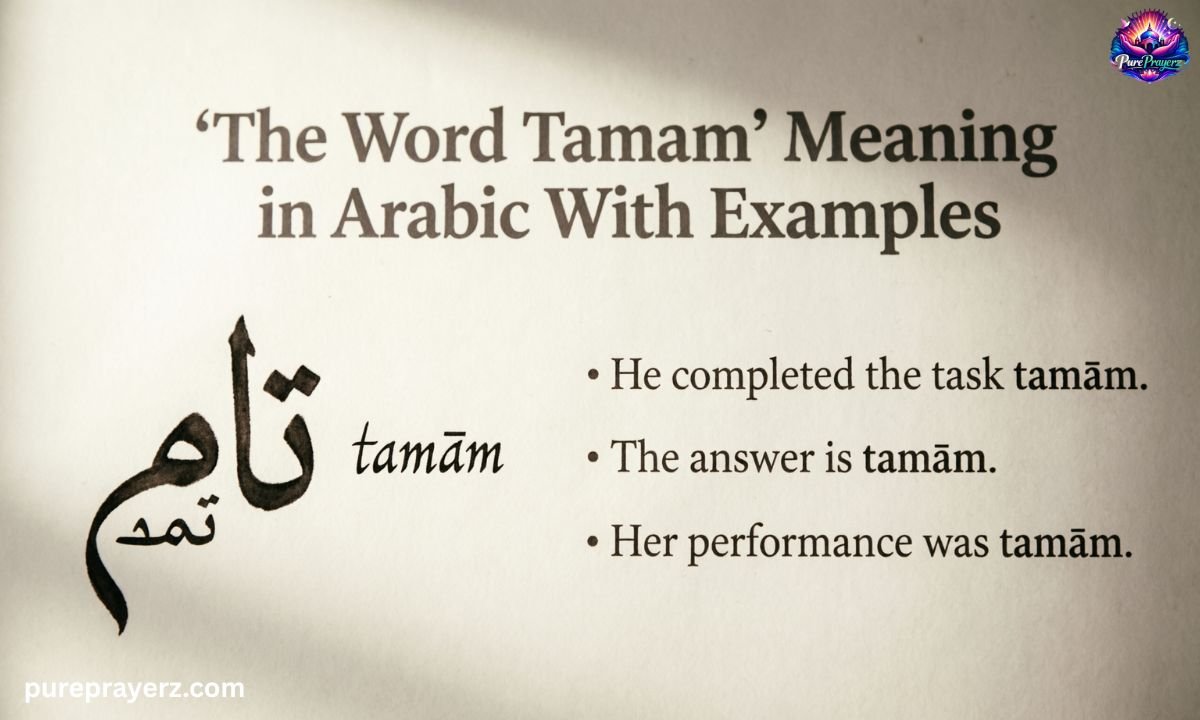
The Arabic language is rich with short words that carry deep meaning, and one of the most widely used among them is Tamam Meaning in Arabic. This article explores how the Arabic word tamam functions across daily conversation, grammar, culture, and Quranic roots. You will learn its complete meaning in Arabic, how it expresses confirmation, agreement, and completion, and why it is often translated as “okay,” “complete,” or “perfect.”
We will break down its linguistic root T-M-M, explain noun, adjective, and verb usage, and provide clear examples of tamam in Arabic sentences. By the end, you will understand how tamam works in Modern Standard Arabic, regional dialects, and religious contexts, making it easier to use naturally and correctly in real-life Arabic communication.
Essential Quick Facts About Tamam in Arabic
| Fact Category | Key Information |
| Word | Tamam (تمام) |
| Language | Arabic |
| Root | T-M-M (ت-م-م) |
| Primary Meaning | Complete, perfect, finished, okay |
| Grammatical Forms | Noun, Adjective, Verb (tamma) |
| Pronunciation | /taˈmaːm/ |
| Common Usage | Daily conversation, confirmation, agreement |
| Regional Variations | Egyptian Arabic, Levantine Arabic, Gulf Arabic |
| Quranic Significance | Appears in contexts of completion and fulfillment; Surah Al-Baqarah 2:185 |
| Related Words | Tamma (تمّ – to be completed), Mutammam (متمّم – completing/perfecting) |
| Cross-Language Use | Turkish: Tamam = okay/done; Farsi: Tamam = complete/finished |
| Practical Examples | “Ana Tamam” = I am fine, “Al-ta’am Tamam” = Food is perfect |
| Learning Importance | Essential for Arabic conversation, daily use vocabulary, and understanding Arabic roots |
| Common Mistakes | Confused with kwayyis (good) or mumtaaz (excellent); overuse in formal writing |
The Tamam Meaning in Arabic
The tamam meaning in Arabic refers to completion, perfection, or confirmation. It is widely used in daily Arabic conversation to indicate that something is fully done or acceptable. Depending on context, it can mean “okay,” “complete,” or “perfect,” making it a versatile and essential word.
In practical use, tamam reassures the listener and confirms understanding. For example, when checking if a task is finished or if everything is fine, saying tamam signals clarity and agreement. Its frequent use in both formal and informal Arabic highlights its importance.
| Usage Context | Meaning | Example Sentence |
| Daily conversation | Okay, alright | هل كل شيء تمام؟ (Is everything okay?) |
| Task completion | Complete, finished | تمّ العمل تمامًا (The work is completely finished) |
| Quality | Perfect | الطعام تمام (The food is perfect) |
Linguistic Root and Grammatical Usage
The word tamam comes from the Arabic root T-M-M (ت-م-م), which conveys the idea of completion and perfection. This root forms several related words, including tamma (to be completed) and mutammam (something that completes). Understanding the root helps learners grasp the deeper meaning behind tamam.
Grammatically, tamam is versatile and can be used as a noun, adjective, or relate to the verb tamma. For example, in “تمّ العمل تمامًا” (The work is completely finished), it describes completion. Learning these forms improves vocabulary and makes daily conversation in Arabic more natural.
Arabic Root T-M-M and Its Meaning
The word tamam comes from the Arabic root T-M-M (ت-م-م), which revolves around the idea of completion and fulfillment. Understanding Arabic roots is essential for mastering vocabulary, and this root appears in many related words.
From this root, we get:
- Tamma (تمّ) – a verb meaning “to be completed”
- Tamam (تمام) – completion or perfection
- Mutammam (متمّم) – something that completes or perfects
These Arabic words from ت-م-م share a consistent meaning, making vocabulary expansion easier.
Tamam Grammatical Usage
From a grammar perspective, tamam grammatical usage is flexible:
- Tamam noun usage: Refers to completion or totality.
- Tamam adjective usage: Describes something as complete or perfect.
- Tamma verb meaning: Indicates that an action has been completed.
This flexibility allows tamam to function naturally in many sentence structures, which is why it appears so often in Arabic word usage examples and daily conversation.
Must Read: Hayawan Meaning in Arabic Explained with Quran & Usage
Examples of “Tamam” in Arabic Sentences

Learning through examples is the fastest way to master tamam in daily Arabic. Below are clear and practical examples of examples of tamam in sentences, showing real usage:
- تمّ العمل تمامًا
(The work is completely finished – work completely finished in Arabic) - الطعام تمام
(The food is perfect – food is perfect in Arabic) - هل كل شيء تمام؟
(Is everything okay? – is everything okay in Arabic) - قال المدير: تمام، نبدأ الآن
(The manager said: Okay, we start now)
These tamam Arabic examples show how the word adapts to formal and informal contexts. Whether confirming completion, expressing agreement, or reassuring someone, tamam remains clear and natural.Using such examples regularly helps learners understand Arabic daily use vocabulary and improves fluency without memorizing complex rules.
Tamam Meaning in Arabic Pronunciation
The correct tamam pronunciation is ta-MAAM, with emphasis on the second syllable. The long “aa” sound comes from the Arabic letter alif (ا), which stretches the vowel.
In phonetic terms, it is pronounced:
- /taˈmaːm/
Clear pronunciation is important because short vowels can change meaning in Arabic. Saying tamam correctly helps avoid confusion with similar-sounding words.
In regional speech, pronunciation may slightly soften, especially in dialects like Egyptian Arabic tamam or Levantine Arabic tamam, but the core sound remains consistent. Mastering this pronunciation early improves listening skills and confidence in Arabic conversation.
Cultural or Quranic Significance of “Tamam”
The concept behind tamam holds strong cultural and religious value. In Arabic culture, completion and fulfillment are associated with responsibility and trust. Saying tamam often signals reliability and closure.
From a Quranic perspective, the root T-M-M appears in verses related to fulfillment and completion. The tamam Quran root reflects the idea of divine perfection and fulfilled commands. A well-known example is completion meaning in Quran found in Surah Al-Baqarah 2:185, which speaks about the completion of prescribed acts.
This verse highlights the importance of finishing obligations fully, aligning with the semantic meaning of tamam. Understanding Quranic Arabic roots like T-M-M deepens both language skills and cultural awareness.
Common Misunderstandings or Mistakes
One common issue among learners is confusing tamam with similar words like kwayyis (good) or mumtaaz (excellent). The comparison tamam vs kwayyis shows that tamam focuses on completion or acceptance, while kwayyis focuses on quality. Similarly, tamam vs mumtaaz shows that tamam does not always imply excellence.
Common Misunderstandings or Mistakes
- Confusing tamam with kwayyis (good) or mumtaaz (excellent), which focus on quality rather than completion.
- Overusing tamam in formal writing instead of more precise or context-specific terms.
- Mispronouncing tamam, especially the long “aa” sound, which can change meaning.
- Using tamam in inappropriate contexts where agreement or confirmation is not required.
- Assuming tamam always means “perfect,” ignoring its broader meaning of completion or okay.
- Forgetting that regional dialects like Egyptian, Levantine, and Gulf Arabic may slightly alter usage or pronunciation.
Another mistake is overusing tamam in formal writing, where more precise terms may be needed. Understanding these common mistakes with tamam helps learners communicate more accurately and professionally.
Must Read: Salam Arabic Meaning: The Secret Behind This Greeting
Why You Should Learn “Tamam”
Learning tamam gives immediate benefits to anyone studying Arabic. It is one of the most essential Arabic word for confirmation and agreement. Knowing how to express agreement in Arabic using tamam makes conversations smoother and more natural.
Because it appears in daily speech, media, and religious texts, mastering tamam strengthens listening, speaking, and comprehension skills. It also builds confidence when learning Arabic conversation words used by native speakers.
Tamam Arabic to English & Urdu
Tamam Arabic to English is commonly translated as “okay,” “complete,” or “finished,” depending on the situation. In conversations, it often works as a confirmation word, similar to saying “alright” in English. The meaning becomes clear through context rather than a fixed definition.
In descriptive use, tamam can also mean “perfect” or “fully done.” For example, when a task is completed or something meets expectations, tamam confirms there is nothing missing. This flexibility makes it an essential word in everyday Arabic communication.
- Tamam translation in English: okay, complete, finished, perfect
Tamam Arabic to Urdu translates to مکمل، ٹھیک، پورا depending on the context. It conveys completion, correctness, or agreement in daily conversation. Urdu speakers often use it to express that everything is fine or fully done.
In practical use, tamam helps communicate understanding clearly. For example, when confirming that work is finished or something is perfect, saying tamam reassures the listener. This makes it a common and useful word in both spoken and written Urdu.
- Tamam in Urdu: مکمل، ٹھیک، پورا
These translations show how tamam functions as both a state and a response word. Understanding cross-language meaning helps bilingual learners apply it correctly.
Tamam Meaning Turkish & Farsi
Interestingly, tamam is also used in Turkish and understood in Farsi. In Turkish, tamam commonly means “okay” or “done,” showing how Arabic influence spread across regions. In Farsi, it retains the sense of completeness, making it familiar to Persian speakers.
| Language | Word Form | Common Meaning | Daily Usage Context |
| Turkish | Tamam | Okay, done, agreed | Used to confirm understanding or acceptance |
| Farsi | Tamam (تمام) | Complete, finished | Used to show completion or satisfaction |
Tamam Meaning in Arabic Letters
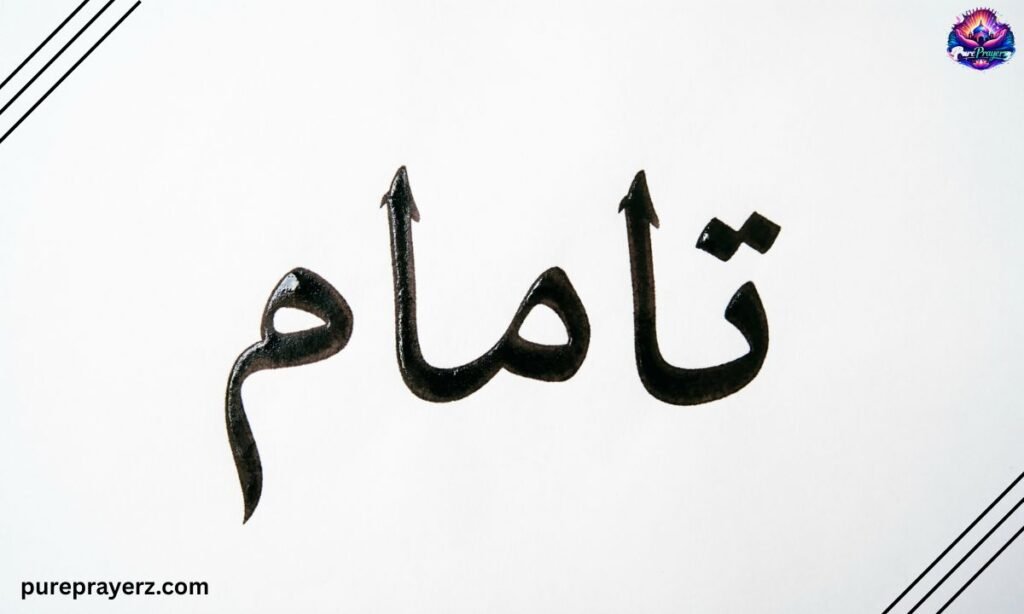
Tamam Meaning in Arabic Letters is written as تمام in Arabic script. These four letters come from the root ت-م-م, which carries the idea of completion and wholeness. Seeing the word in its original script helps learners connect sound with meaning.
Recognizing تمام in written Arabic improves reading fluency and vocabulary recall. It commonly appears in daily Arabic use, messages, and simple texts. Learning the letters also helps you identify other Arabic words built from the same root.
In Arabic script, tamam is written as:
تمام
Recognizing the word visually helps with reading comprehension and vocabulary recall, especially for beginners.
Must Read: Khalid Meaning: Uncover Its Powerful and Eternal Secret
Ana Tamam Meaning
The phrase ana tamam (أنا تمام) means “I am fine” or “I’m okay.” It is a direct and friendly response in conversation and one of the simplest ways to express personal well-being in Arabic.
Tamam Meaning in Arabic at pureprayerz.com
On pureprayerz.com, tamam meaning in Arabic is explained with clarity, focusing on spiritual, linguistic, and daily-use contexts. The emphasis is on helping readers understand both meaning and usage without confusion, especially for learners exploring Quranic Arabic and everyday expressions.
Frequently Asked Questions
What does Tamam mean in Arabic?
Tamam means “complete,” “okay,” or “perfect” in Arabic. It is used to confirm understanding, agreement, or that something is fully finished.
How do you pronounce Tamam in Arabic?
Tamam is pronounced ta-MAAM, emphasizing the second syllable. The long “aa” sound comes from the Arabic letter alif (ا).
What is the root of Tamam in Arabic?
The root of tamam is T-M-M (ت-م-م), which conveys completion, wholeness, and perfection. It forms related words like tamma and mutammam.
Can Tamam be used as a noun or adjective?
Yes, tamam can be a noun for completion, an adjective for something perfect, or relate to the verb tamma meaning “to be completed.”
How is Tamam used in daily Arabic conversation?
In daily conversation, tamam expresses agreement, confirms instructions, or shows that everything is fine. It’s widely used in Egyptian, Levantine, and Gulf Arabic.
What is the meaning of Ana Tamam?
Ana tamam (أنا تمام) means “I am fine” or “I’m okay.” It’s a simple, friendly response to show personal well-being.
How is Tamam used in the Quran?
The root T-M-M appears in the Quran, emphasizing completion and fulfillment. For example, Surah Al-Baqarah 2:185 mentions the completion of prescribed acts.
What are common mistakes with Tamam?
Learners often confuse tamam with kwayyis (good) or mumtaaz (excellent). Tamam focuses on completion, not necessarily quality or excellence.
Conclusion
The Arabic word tamam may seem simple, but it carries layers of meaning rooted in language, culture, and faith. From confirmation and agreement to completion and perfection, tamam plays a vital role in Arabic communication. Its root T-M-M connects everyday speech with Quranic concepts of fulfillment, making it both practical and profound.
By learning how tamam works in grammar, pronunciation, and real-life examples, you gain a powerful tool for Arabic conversation. Whether you are confirming understanding, describing finished work, or expressing reassurance, tamam helps you speak Arabic more naturally and confidently.